Most travel blogs still describe Crete as one of Europe's affordable Mediterranean destinations. That label stuck from a decade ago and nobody has bothered updating it. In 2026, after three consecutive record tourism seasons and a full post-pandemic price reset across Greek hospitality, it needs a hard correction.
We have tracked prices on the ground for five years, from studio apartments to car rentals to what a plate of fresh fish actually costs at a harbor taverna. Here is what a trip to Crete will cost in 2026, which categories are still worth it, and where the budget-destination narrative continues to mislead travelers before they even book their flights.
- The affordable Crete myth in 2026
- Accommodation: the real price floor
- Food: tavernas vs tourist traps
- Car rental: the bill nobody mentions
- Beach sunbeds: the silent daily charge
- Free beaches that are worth the detour
- When to go if budget is a constraint
- The honest daily budget: low, mid, high
The affordable Crete myth in 2026
Type budget travel Crete into any search engine and you will find dozens of posts promising a full week for 500 to 700 euros per person. These articles share one characteristic: they are outdated, most written between 2018 and 2022, and none of them account for the sharp price increases that have reshaped Greek hospitality over the past three years.
To put a single number on it: a mid-range double room in a well-located area now costs between 90 and 140 euros per night in high season. That one line item already exceeds most of the daily budgets circulating online. Seven nights in that room runs 630 to 980 euros before a single meal, taxi, or entrance ticket is added.
Crete is not overpriced for what it delivers. It has simply stopped being inexpensive. Travelers who arrive in July expecting 2019 prices will spend their first two days recalibrating under pressure. The sooner you work from accurate numbers, the more useful your planning becomes.
- Estimated hospitality price increase since 2019: 35-45%
- Budget hostel dormitory: 25-40 EUR/night in season
- Mid-range double room: 90-140 EUR/night July-August
- Private villa (3 bedrooms): 250-500 EUR/night at peak
Accommodation: the real price floor
Accommodation is where Crete hits hardest in July and August. There is almost no affordable private accommodation left in the popular coastal areas during peak weeks. A studio apartment that rented for 45 euros in 2019 is now listed at 85 to 100 euros and books out three months in advance.
The cheapest credible option remains a hostel dormitory bed at 25 to 40 euros per person. Private rooms in guesthouses start around 65 euros for a basic double. Anything with a sea view or pool in a well-connected location starts at 120 euros.
The real savings come from staying inland, choosing the less developed western or central parts of the island, or shifting your dates to shoulder season. The same room that costs 110 euros in August drops to 55 to 70 euros in late May. That single decision is more impactful on total trip cost than any other spending choice you can make.
- Hostel dorm (per person): 25-40 EUR/night
- Basic guesthouse double: 65-90 EUR/night
- Mid-range hotel with pool: 110-160 EUR/night
- Off-season discount (May vs August): typically 40-50% reduction
Food: tavernas vs tourist traps
Greek food remains one of the strongest arguments for Crete as a value destination. A genuine local taverna meal, one main course, shared starters, house wine, and water, costs 15 to 22 euros per person. That price point is real and still exists, but only if you eat where locals eat and not where tourist infrastructure funnels you.
The harborfront strips of the popular northern resorts operate on a different pricing logic. In these zones, a basic meal routinely costs 30 to 45 euros per person. The fish is often frozen, the portions are smaller than what you will find two streets back, and what you are paying for is proximity to the beach umbrella rental desk.
A reliable rule: walk at least three streets inland from any organized beach before sitting down to eat. Check whether the menu has photos. If it does, keep walking. The best food in Crete comes on a chalkboard with a handwritten translation, not on laminated plastic. Self-catering from local supermarkets runs 10 to 15 euros per person per day and is a workable option for breakfasts and lunches.
- Local taverna (main + starter + wine): 15-22 EUR/person
- Tourist harbor area meal: 30-45 EUR/person
- Supermarket self-catering (per day, per person): 10-15 EUR
- Greek coffee: 2.50-4.50 EUR depending on location
Car rental: the bill nobody mentions
Car rental is the line item most travel guides either underestimate or bury quietly in a catch-all transport category. In Crete, a car is not optional for most itineraries. The island stretches roughly 260 km east to west, buses are infrequent outside the main northern highway corridor, and the best beaches are not reachable without wheels.
In July and August, a compact car with full insurance from the main airport runs 45 to 75 euros per day if booked last minute. Book three months in advance and the same car costs 30 to 45 euros. The insurance detail matters: the base liability excess on a standard rental can be 800 to 1,500 euros. Coastal access roads and mountain tracks are significantly more demanding than roads further north in Europe, making full coverage not a luxury but a practical necessity. That adds 10 to 15 euros per day.
A week of car rental booked early with complete coverage comes to 250 to 350 euros. Split between two people, that is 18 to 25 euros per person per day. It is a fixed cost most bloggers either absorb into a vague category or omit entirely.
- Last-minute peak season compact: 65-100 EUR/day
- Advance booking (3 months prior): 30-45 EUR/day
- Full insurance upgrade: 10-15 EUR/day
- Petrol (per liter): approximately 1.80-2.00 EUR
Beach sunbeds: the silent daily charge
Organized beaches charge for sunbed and umbrella sets. The standard rate is 10 to 20 euros per set, per day. Two people sharing one set pay that fee for the privilege of sitting on sand that would theoretically be free. At Palm Beach Vai on the east coast, prices run at the top end of that range during July and August. At Agia Pelagia Beach on the central north coast, a popular stop for independent travelers, the same setup runs 12 to 15 euros.
Across a week-long trip, organized beach sunbeds add 70 to 140 euros per couple. This cost appears in almost no online budget guide because it does not fit neatly into any standard spending category. You discover it when you arrive at the beach and find no free space outside the organized section.
The fix is direct: choose beaches without organized infrastructure. They exist, they are often better, and several of the worthwhile ones are listed in the next section.
- Sunbed and umbrella set: 10-20 EUR/day per set
- Palm Beach Vai peak season: 18-22 EUR per set
- Agia Pelagia Beach typical rate: 12-15 EUR per set
- Weekly cost per couple at organized beach daily: 70-140 EUR
Free beaches that are worth the detour
The most visited beaches in Crete are not the best ones. Several of the island's genuinely impressive stretches of coast have no sunbed operators, no access fees, and no shuttle buses. They require a car and sometimes a short drive on a dirt track. That filters out enough casual day-trippers to keep them usable.
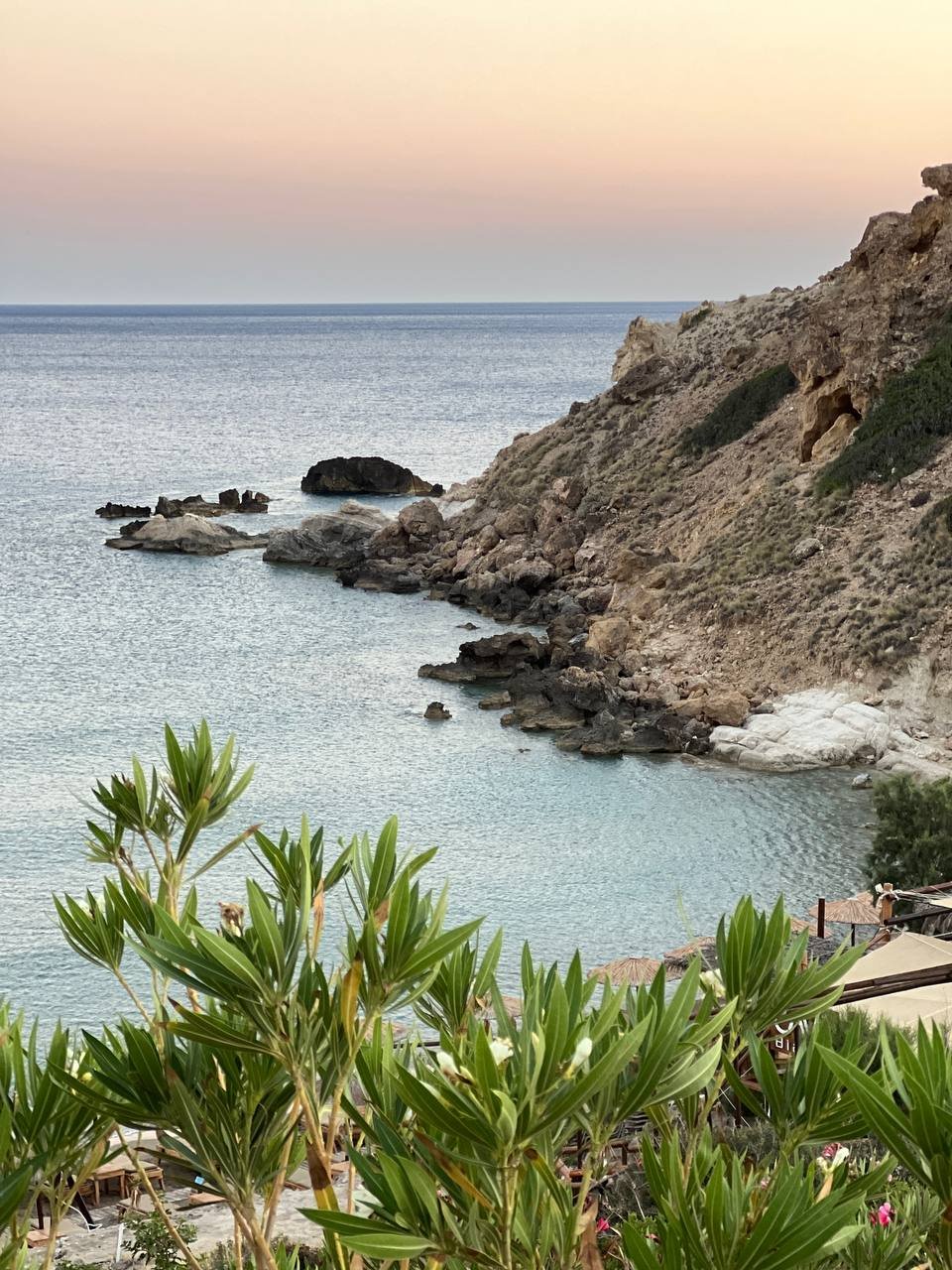
Krassas Beach on the central coast has no organized services at all, no sunbed operators, no beach bars, only sand and water. It sits at the end of a road rough enough to discourage most standard rental cars. Bring a mat, arrive before midday, spend nothing. Mikri Triopetra Beach on the central south coast is a double bay with clear, shallow water and one taverna near the car park that operates independently of the beach itself. Skinias Beach on the east coast stays low-footfall even in August because it is genuinely off the main circuit.
Pera Galini, a small settlement on the central coast, has a beach with no organized services and two or three tavernas directly behind it. It is one of the places where the Cretan coast still looks like it did before mass tourism normalized organized beach infrastructure everywhere.
- Krassas Beach: free access, central coast, no services
- Mikri Triopetra Beach: free access, central south, one taverna nearby
- Skinias Beach: free access, east coast, low footfall year-round
- Pera Galini beach: free access, village setting on the central coast
When to go if budget is a constraint
Timing is the most powerful budget variable available to you. July and August carry a premium across every spending category, not just accommodation. Car rental prices spike. Ferries and internal transfers cost more. The informal pricing flexibility that comes with quieter periods disappears entirely.
May is the most compelling value month in Crete. Temperatures run consistently between 22 and 28 degrees Celsius. The sea is swimmable from the last week of May onwards. Nearly all beaches and attractions are open. Accommodation prices are roughly half their August peak. You can visit Palm Beach Vai without midday queues, reach Krassas Beach before it fills up, and eat at Pera Galini without waiting for a table. A mid-range independent traveler in May spends approximately 30 to 40 percent less per day than on the same itinerary in August.
October is the second-strongest month for value. The sea stays warm well into the month, temperatures hold around 22 to 25 degrees, and prices drop sharply from the September shoulder. Some smaller tavernas begin closing in late October, but the core infrastructure remains operational.
- May: best value, all services open, sea swimmable from late May
- June: good balance, prices 20-30% below peak
- July-August: 40-55% premium across all categories
- October: second-best value month, warm sea, some closures late in the month
The honest daily budget: low, mid, high
Here is what a day in Crete costs per person in July-August 2026. No optimistic assumptions, no costs shared across a group of six, no meals skipped.
Low budget, 80-110 EUR per person per day: Dormitory bed at 30-35 euros, one restaurant meal at 18-20 euros, self-catering for other meals at 12 euros, half the daily car rental at 20-25 euros, free beaches only. This is achievable but requires consistent discipline. It means no spontaneous decisions to sit at a harbor taverna or rent sunbeds for the afternoon.
Mid budget, 130-180 EUR per person per day: This is what most independent travelers actually spend. A private double room split two ways at 60-80 euros per person, eating out twice daily at 40-55 euros total, car rental at 20-25 euros per person, occasional sunbeds at 8-10 euros per person. This range is comfortable and does not require constant financial vigilance.
High budget, 250 EUR and above per person per day: Private hotel with pool, organized beaches daily, restaurant dinners every evening. This is the figure many review sites describe as an affordable holiday. It is comfortable. It is not a budget.
- Low: 80-110 EUR/person/day (July-August, strict choices)
- Mid: 130-180 EUR/person/day (typical independent traveler)
- High: 250+ EUR/person/day (hotel, restaurants, organized beaches)
- Same low budget in May: 50-70 EUR/person/day
Verdict
Crete is worth it. The food is good, the coast is exceptional, and outside peak season the prices are reasonable. But the budget-destination framing that dominated travel content for years no longer holds for a July or August trip. Go in May or October, choose free beaches over organized ones, eat inland rather than at the harbor, book your car three months out, and the numbers work. Arrive in August with a 700-euro weekly budget and you will spend your holiday managing a spreadsheet instead of enjoying the island.