Every day, tourists in Heraklion walk the same circuit: the harbor, the Koules fortress, a selfie, a souvlaki. They admire the massive stone walls encircling the old city, assume they are old, and move on to the next beach. What they are walking past is the site of the longest siege in early modern European history. Twenty-two years. One city. The most sophisticated military engineers in the world on both sides. And almost nobody talks about it.
The Siege of Candia lasted from 1648 to 1669, a conflict so grinding and so costly that it depleted the Ottoman Empire's resources for a generation and ended Venice's status as a Mediterranean power. It was fought with tunnels, mines, counter-mines, naval blockades, plague, and attritional warfare that makes the trench battles of 1914 to 1918 look brief by comparison. The walls that survived it are still standing. You probably photographed them this morning.
- When Candia was the most fortified city in the Mediterranean
- Why Venice fought 22 years over one island
- The Maltese galley that triggered a 22-year war
- The military engineering that held the city
- The relief expeditions that came too late
- The real human cost: what the numbers mean
- September 1669: the surrender that changed the Mediterranean
- What you can actually see in Heraklion today
- The 229 years tourists forget
When Candia Was the Most Fortified City in the Mediterranean
By 1640, Candia (the Venetian name for what is now Heraklion) was a city of approximately 30,000 inhabitants surrounded by walls that had taken a century to build. Venice had controlled Crete since 1204, when the island fell to them after the Fourth Crusade reshuffled the eastern Mediterranean. In those 465 years, the Venetians turned their colony into the most commercially valuable hub in the region and built the defenses to match.
The fortifications were designed by Michele Sanmicheli, the foremost military architect of the 16th century. His bastion system, later called the trace italienne, replaced high medieval walls with low, thick, angled structures that deflected cannonballs rather than shattering under them. The walls reached up to 40 meters thick in key sections, built of compacted earth and masonry designed to deform rather than crack under bombardment.
When the Ottoman Empire decided Crete was worth taking, their generals examined these walls and understood the problem. They did not attempt a quick storm. They dug in for a long campaign. Twenty-two years later, they still had not broken those walls by force. They only entered through a negotiated surrender. That distinction matters.
- Venetian control of Crete: 1204 to 1669 (465 years)
- Wall perimeter: approximately 3 kilometers
- Construction period: roughly 1462 to 1562 (one hundred years)
- Key designer: Michele Sanmicheli, commissioned 1538
Why Venice Fought 22 Years Over One Island
Venice did not spend 22 years fighting for Crete out of sentiment. The island was the economic engine of the Venetian maritime empire. Crete produced grain, olive oil, and malmsey wine, a variety so prized across Europe that Shakespearean England consumed it by the cask. Above all, it provided the naval base that kept Venetian trade routes to the Levant open. Without Crete, Venice's commercial position in the eastern Mediterranean collapsed entirely.
There was also the symbolic dimension. Losing Crete would signal to every rival power that Venice was in terminal decline. The Republic poured men, ships, and money into the defense decade after decade, even as the costs became ruinous. Contemporary Venetian treasury estimates put the total expenditure over 24 years at approximately 1.2 billion ducats, a sum that permanently weakened the Republic's finances and accelerated its long decline.
What often goes unmentioned is that the Cretan Greek population fought alongside the Venetians. After four centuries of integration, and despite periodic revolts against Venetian authority over the generations, the local population had no desire to exchange one colonial master for the Ottoman alternative. The defense of Candia was a joint effort. The names on the casualty lists were not all Venetian.
The Maltese Galley That Started a 22-Year War
The immediate cause was an act of piracy with serious diplomatic consequences. In September 1644, Knights of Malta intercepted an Ottoman convoy in the Aegean. Among the captives was a high-ranking figure connected to the imperial court. The Ottoman government accused Venice of facilitating the attack, claiming Venetian-controlled ports in Crete served as a staging point for the raid.
Venice denied involvement, and the denial was credible: the Knights of Malta operated independently of Venetian authority. It did not matter. The decision to move on Crete had already been made at the Sublime Porte. On June 23, 1645, Ottoman forces landed on the western tip of Crete with an army estimated at 50,000 to 60,000 troops. The western coast fell with speed: the main city of the west in August 1645, the central coastal city in November 1646.
By 1648 the Ottomans controlled virtually all of Crete except for three fortified outposts. The most important was Candia. The formal siege began that year. What followed was not the dramatic assault most people imagine. It was a war of tunnels, slow attrition, and periodic catastrophic engagements in the dust and heat of a city that had long since ceased to function as anything other than a defended perimeter.
The Military Engineering That Held the City
The Venetian walls of Candia are not simply old. They represent the cutting edge of 16th-century military technology applied to a problem that resisted solution for 22 years. Sanmicheli's bastion system created overlapping fields of fire: any force attacking one section of wall came simultaneously under fire from defenders positioned at the adjacent bastions. Direct assault was effectively suicidal in every direction at once.
The Ottoman response was mining. Engineers dug tunnels beneath the bastions, packed them with gunpowder, and detonated them to collapse the walls from below. Historical records document more than 500 mine explosions during the 22-year siege. The Venetian counter-response was to dig their own tunnels, listening for Ottoman excavation and racing to intercept it. Underground engagements between rival mining parties were among the most brutal episodes in an already brutal war.
Both sides deployed the most advanced military engineering of the era. Ottoman siege lines were sophisticated permanent constructions with their own fortifications, supply routes, and field hospitals. The Venetians developed counter-fortification methods that influenced military architecture across Europe for the following century. What visitors see today as a pleasant walk around old walls was, for 22 consecutive years, an active battlefield operating 24 hours a day.
- Documented mine explosions during the siege: over 500
- Bastion system: overlapping fire eliminates any dead ground on approach
- Wall thickness: up to 40 meters in critical sections
- Martinengo Bastion on the south side: largest surviving bastion, still intact
The Relief Expeditions That Came Too Late
Venice could not sustain the siege alone. The Republic appealed repeatedly to Catholic Europe for military support, framing the defense of Candia as a crusade against Ottoman expansion into Christian territory. The response from European powers was inadequate, consistently delayed, and ultimately fatal to the defense.
Several expeditions arrived during the 22 years, each providing temporary relief without changing the fundamental equation. The largest came in 1669, when Louis XIV of France authorized a major expedition under François de Vendôme, the Duke of Beaufort. Approximately 7,000 French soldiers joined the defense, the largest Western reinforcement of the entire conflict.
Initial French operations showed results. Siege lines were broken in several places and for a brief period the Ottoman grip seemed to loosen. Then on August 25, 1669, a major sortie ended in catastrophe. The Duke of Beaufort was killed, his body never recovered. French casualties in a single day eliminated their capacity to continue. Within two weeks the French fleet withdrew entirely, leaving the Venetian garrison, by then fewer than 4,000 effective defenders, facing a force that had not diminished in strength across two decades. Francesco Morosini opened surrender negotiations the following month.
The Real Human Cost: What the Numbers Mean
The aggregate casualty figures vary between sources but the range most historians accept is consistent. Ottoman forces lost somewhere between 100,000 and 140,000 dead over 22 years, from combat, disease, and the conditions of extended siege warfare in summer heat on an island with limited fresh water. Venetian and Cretan defenders lost an estimated 30,000 to 40,000 soldiers and civilians.
What those numbers mean in practice: by September 1669, the city that housed 30,000 people in 1648 was a starved, depleted garrison. The Black Death swept through Candia multiple times during the siege. Supply shortages were chronic in the final years. Defenders were dying faster than reinforcements arrived. The walls held. The people defending them did not.
This was not a siege that ended because one side ran out of resolve. It ended because arithmetic caught up with courage. Every family inside Candia had lost members. Every neighborhood bore the marks of Ottoman artillery and the psychological weight of 22 years under siege, watching relief expeditions arrive and fail in succession. That collective trauma shaped Cretan memory for generations, even as it was subsequently suppressed under Ottoman administration and later filtered through Greek nationalist historiography.
September 1669: The Surrender That Changed the Mediterranean
Francesco Morosini, Venetian Captain-General of the Sea, signed the capitulation on September 5, 1669. The terms were considered honorable by contemporary standards: defenders who wished to leave could do so with their arms, their possessions, and their lives. Those who chose to remain under Ottoman rule were permitted to stay.
Morosini removed what he could before departing: artworks, relics, documents, and architectural elements of value. Venetian lion reliefs that had decorated the city gates were taken down. Marble columns from the harbor were shipped back to Venice. The Morosini Fountain that visitors photograph today in Heraklion's central square was built years before the surrender but carries his name as a vestige of the Venetian era.
Back in Venice, Morosini faced trial for surrendering a city entrusted to his defense. The Council of Ten acquitted him: the record made clear no other outcome was possible given the circumstances. He went on to further campaigns, most notably a 1687 assault on the Peloponnese during which his artillery accidentally destroyed a significant portion of the Parthenon, then being used by the Ottomans as a powder magazine. The 17th century was not kind to ancient monuments.
The Ottoman flag flew over Candia from September 1669. The city was renamed Megalo Kastro, the Great Castle. It would remain under Ottoman administration for the next 229 years.
What You Can Actually See in Heraklion Today
The physical evidence of the siege is extensive and largely free to access. Most visitors miss it because no one explains what they are looking at.
The Venetian walls are the obvious starting point. The full perimeter runs approximately 3 kilometers and is partially walkable from the top. The Martinengo Bastion on the south side is the largest and best-preserved section. Standing on it, you look directly across the terrain the Ottoman forces used for their approach: a landscape that today is residential streets and parked cars but for 22 years was a field of mines, counter-mines, and daily skirmishes. Budget at least an hour.
The Koules fortress at the harbor entrance is the most photographed Venetian structure in Heraklion. Built and rebuilt by the Venetians over three centuries, it was the last line of harbor defense. The interior has been restored with a modest exhibition on the Venetian and siege periods. Go before 10am to avoid tour groups. The Historical Museum of Crete, a short walk from the harbor, covers the Venetian and Ottoman periods with depth that the Archaeological Museum does not attempt. It is chronically undervisited and arguably the most informative place in the city for understanding what Heraklion actually is.
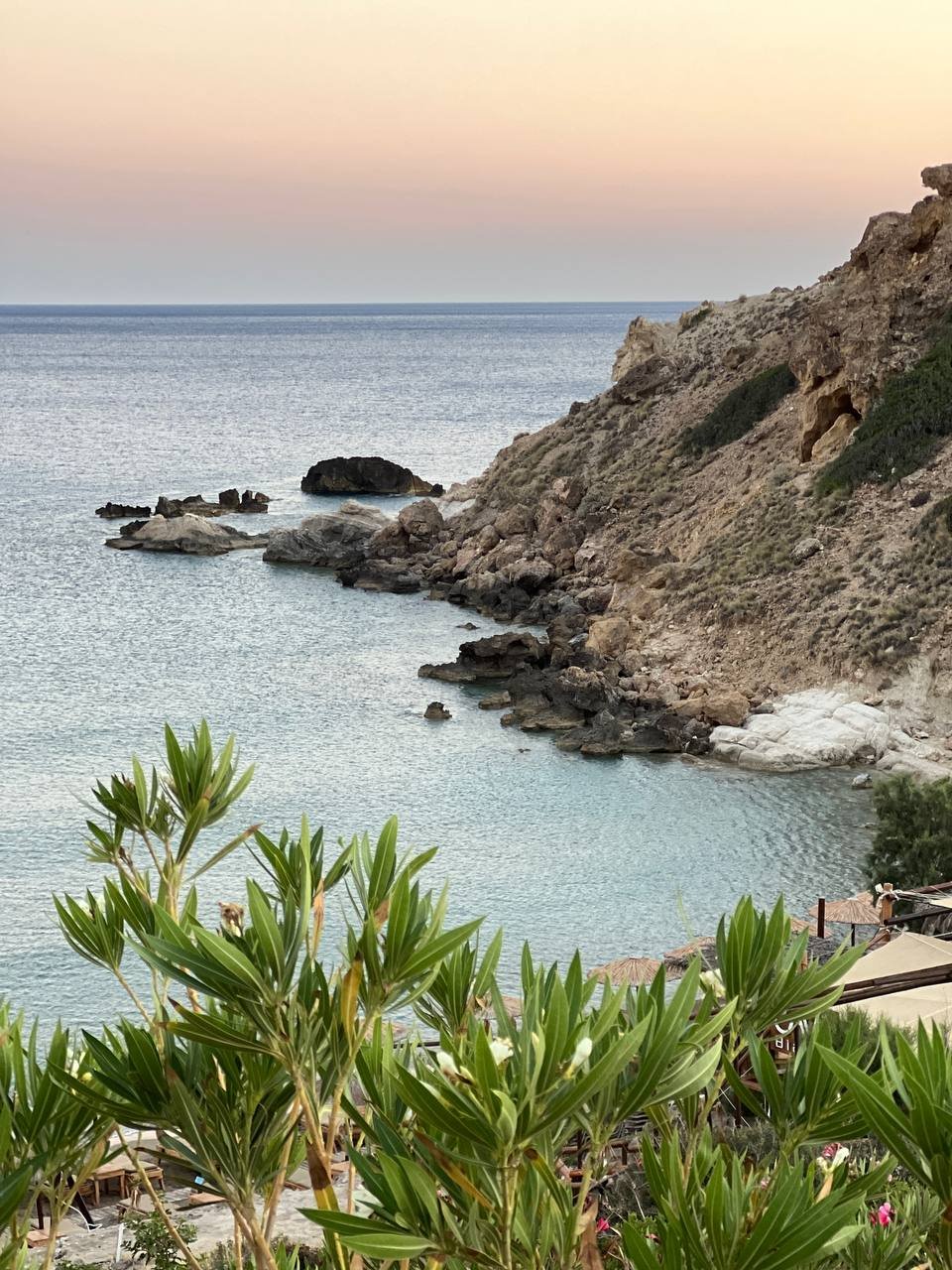
If you want to decompress after a day of heavy history, the quieter coves of the central north coast are close. Pera Galini, east of the city, offers a low-key beach backed by small fishing activity, the same sea the Venetian relief fleets crossed, with considerably less artillery fire than 1669.
The 229 Years Tourists Forget
The Ottoman period lasted from 1669 to 1898, which is 229 years. That is longer than the United States has existed as an independent country. Most tourists in Heraklion today would struggle to identify a single building or institution that dates from those 229 years. This invisibility is not an accident.
After the Greek War of Independence on the mainland ended in 1829, Crete remained under Ottoman administration. A succession of major uprisings followed: 1866 to 1869, which generated significant European press coverage centered on the Arkadi Monastery episode; 1878; and 1897. Each was suppressed. Each time, the Great Powers promised intervention and provided minimal practical support.
Crete finally achieved effective autonomy in 1898 when Britain, France, Russia, and Italy established a Cretan State under nominal Ottoman suzerainty. The island formally unified with Greece in 1913. The political transition of 1898 was followed by systematic conversion or demolition of Ottoman-era architecture. Mosques became churches, were repurposed, or disappeared entirely. The Ottoman layer was physically edited out of the built environment wherever the new authorities had the means to do so.
The most visible Ottoman architectural legacy in Crete today survives not in Heraklion but in Rethymnon on the central coast, where several mosques remain standing, one now functioning as a music conservatory. In Heraklion the Ottoman traces are subtler: certain street geometries, fountain niches embedded in building facades, architectural details that do not quite fit the Venetian narrative the city prefers to present. Look for them deliberately. They are there.
The walls are still there. The bastions are intact. The Koules fortress is as photogenic as it was when the Ottoman fleet first appeared on the horizon in 1648. The difference between walking past it and understanding it is knowing what you are actually looking at: the surviving evidence of 22 years of the most sustained military effort in early modern European history, fought over an island both sides considered worth dying for in extraordinary numbers. The walls held. The empire that built them did not. That is what these stones are.