Crete vs Santorini for Families: The Honest Verdict
Every year, thousands of families book Santorini because the photographs are spectacular. White-washed houses, blue-domed churches, sunsets over the caldera. Then they arrive with two children under ten, a folded stroller, and a real budget, and reality arrives fast.
We have been based in Crete for five years. We watch this pattern repeat every summer. Santorini is a legitimate destination for couples with money and minimal luggage. For families with children, it is almost always the wrong choice. Here is what the glossy travel sites consistently skip.
- The Santorini trap for families
- Beaches: the fundamental difference
- Budget: what you actually spend
- Activities with children
- Logistics, strollers, and cobblestones
- Food and eating out
- Size: 76 km² vs 8,336 km²
- When Santorini actually works
- The verdict
The Santorini Trap for Families
Santorini is positioned as the quintessential Greek destination. Travel magazines, Instagram feeds, and wedding blogs have spent two decades building that image. The problem is that the entire tourism infrastructure of the island is built around couples, honeymooners, and photographers chasing the same 40 blue domes. Children are, tactfully, an afterthought.
The beaches on Santorini are volcanic. The sand is black or dark grey and absorbs heat aggressively. In July and August, surface temperatures regularly exceed 55°C. Walking barefoot is genuinely painful. Water entry on most beaches is abrupt, with no shallow paddling zone for young children. For a four-year-old, this means a very short and unhappy beach experience.
The towns of Oia and Fira, which generate most of the iconic images, sit on steep caldera cliffs. Streets are narrow, paved with irregular stones, and broken up by staircases. During peak season, the paths are packed shoulder-to-shoulder with tourists. It is an environment optimised for a honeymoon photograph, not for a family with a stroller and a six-year-old asking for ice cream. The tourism machine is finely tuned for couples spending four nights on a terrace with a view. Families with children are tolerated, not designed for.
Beaches: The Fundamental Difference
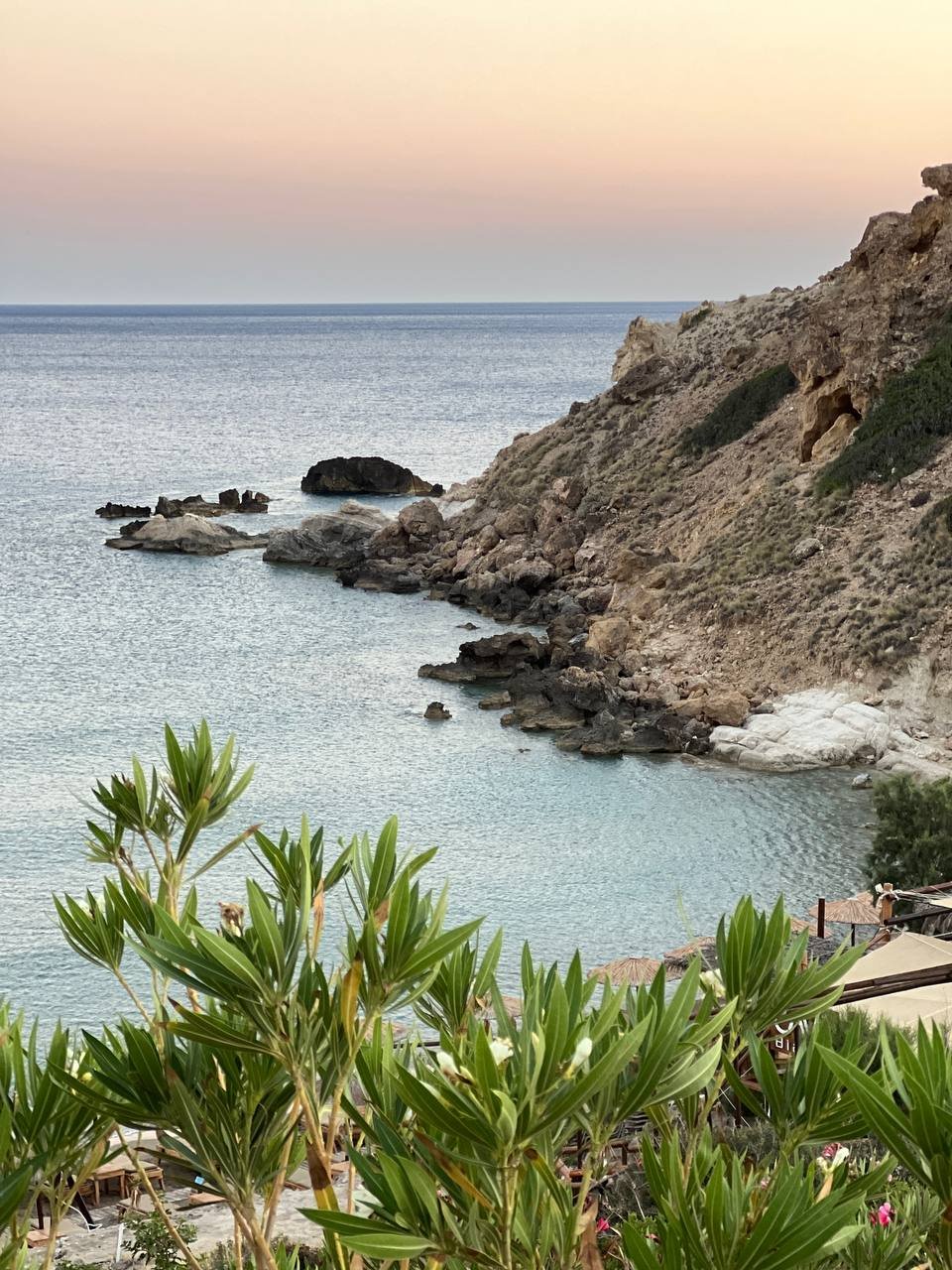
This is the most important practical gap between the two islands, and it is not close. Crete has over 1,000 kilometres of coastline. The variety is enormous: long flat sandy bays with gradual depth increases ideal for young swimmers, sheltered coves, clear water over shallow rock. The beaches on Crete are, categorically, better suited to families.
Plakias Beach on the central coast is a reliable benchmark. A long sandy bay, calm water in the mornings, tavernas at the back, shallow entry for 20 to 30 metres. Young children can walk in without being knocked over. Finikas Beach on the west coast is sheltered and calm, well suited to children who are nervous in the water. Rethymnon Beach stretches for several kilometres along the north-central coast with a full town directly behind it, meaning restaurants, playgrounds, and shade within walking distance.
Santorini's main family-accessible beaches, Perissa and Kamari, are functional. They have facilities, clear water, and amenities. But the black sand requires beach shoes throughout summer, the seabed drops relatively quickly, and the overall experience is not in the same category as what Crete offers in sheer volume and variety.
- Plakias Beach: long sandy bay, shallow entry, calm mornings, central coast
- Finikas Beach: sheltered, west coast, ideal for young swimmers
- Rethymnon Beach: kilometres of sand, full town behind, north-central coast
Budget: What You Actually Spend
Real numbers. A decent three-bedroom villa or apartment in Santorini in July 2024 runs between 350 and 600 EUR per night. The equivalent in Crete, same quality and size, costs between 100 and 200 EUR per night. On a ten-night stay, that is a difference of 1,500 to 4,000 EUR in accommodation alone.
Restaurants in Santorini charge a premium that has nothing to do with food quality and everything to do with the caldera view below. A main course for an adult runs 22 to 38 EUR in a mid-range establishment. In Crete, the same meal costs 12 to 18 EUR. A family dinner for four in Santorini: 120 to 180 EUR. In Crete: 60 to 90 EUR. Every single night.
Santorini also lacks a meaningful supermarket culture in its tourist centres, which forces near-total restaurant dependence. Crete has large supermarkets in every town, making self-catering straightforward and cheap. Over two weeks for a family of four, the total cost difference between the two islands routinely reaches 4,000 to 6,000 EUR. That is not a rounding error. That is a second holiday.
Activities With Children
Ask any honest Santorini regular what there is to do with children and the list is short: the volcano boat tour (45 minutes, very hot, not recommended under six), a donkey ride (increasingly controversial), and the caldera view. That is approximately two days of content on an island that families typically book for seven nights. By day four, most families are sitting by their pool wondering what to do next.
Crete offers a genuinely different volume of activities. The island has Minoan archaeological sites that engage older children with a concrete story about the oldest civilisation in Europe. There are boat trips to sea caves and secluded bays on every coast. Several large waterparks operate near the north coast towns. The natural landscape, from the western mountain ranges to the inland plateau region, offers age-appropriate walking routes that require no technical preparation.
A family spending ten to fourteen days in Crete can build genuinely varied days: a beach morning, an ancient site late morning, a mountain drive in the afternoon, a fishing village for dinner. In Santorini, you have the view. It is a remarkable view. But it is one view, and it does not fill a week for a family with active children who need more than a terrace and a sunset.
Logistics, Strollers, and Cobblestones
Santorini's most famous villages are built on volcanic cliffs. Oia has approximately 300 steps connecting the upper village to the port. Fira is similar. The main caldera path is paved with irregular stones that are beautiful in photographs and relentless on wheels. Getting a stroller from point A to point B in Oia in August involves carrying the child more than pushing the stroller. This is not a minor inconvenience over seven days; it is a constant physical and logistical drain.
Taxis in Santorini are expensive by island standards, in short supply during peak hours, and the roads across the island are narrow and frequently congested. Renting a car with multiple child seats, navigating village lanes, and finding parking in tourist areas adds cumulative stress that families routinely underestimate in the booking phase.
Crete is car-oriented by design. The north coast arterial road connects the main towns efficiently. Beach parking exists at most locations. The island's principal tourist towns are largely flat and navigable on foot. The road infrastructure was built to accommodate families with full cars and luggage, which matches exactly how visiting families actually travel. The practical difference registers on day one and compounds every day after.
Food and Eating Out With Kids
Crete has one of the most recognised food cultures in Greece. Olive oil, olives, fresh fish, lamb, and seasonal vegetables form the backbone of a cuisine with strong roots in the Mediterranean diet tradition. The food is honest, varied, and competitively priced in village tavernas across the island. Locals eat at these places too, which keeps quality up and prices grounded.
Children eat well in Crete without negotiation. Greek-style grilled meat, fresh bread, tomato salads, and simple grilled fish are universally acceptable to kids. The taverna culture means meals are relaxed and unhurried, well suited to families who need a table for two hours without pressure to turn it over. Near beaches on the central and west coasts, competitive pricing is the norm.
Santorini's restaurant scene is technically competent in its top tier. Ingredients are good, presentations polished. But you pay a 30 to 40% premium across the board for the view and the brand positioning, and the children's menu is not the reason anyone books a table in Oia. For families, Crete's food proposition is superior in value, variety, and atmosphere.
Size: 76 km² vs 8,336 km²
Santorini covers 76 km². The main tourist circuit, meaning Oia, Fira, the caldera villages, and the two main beaches, can be completed in two to three days. Most families who book a seven-night stay report feeling restless and under-stimulated by day four. There is nowhere meaningfully new to go. The island has been built and zoned almost entirely for upscale tourism, which means you are constantly inside the machine rather than beside it.
Crete is 8,336 km², making it the largest Greek island and the fifth largest in the Mediterranean. The east coast, central coast, and west coast are genuinely different environments with different characters, different landscapes, and different things to do. A family can spend fourteen days in Crete without repeating a single beach, village, or drive.
That scale also means you can step outside the tourist circuit when you need to. There are villages in the interior of Crete three hours from the nearest resort town, entirely oriented toward local life. For families who want their children to have a genuine travel experience rather than a packaged resort loop, the size of Crete is a structural advantage that Santorini cannot replicate. Crete is a place you explore. Santorini is a place you photograph.
When Santorini Actually Works
This comparison is not an argument that Santorini is a bad destination. It is an argument that Santorini is the wrong destination for most families with young children. The distinction matters because Santorini is genuinely good at what it does.
Santorini works very well for couples and adults travelling without children. The caldera view is real and worth seeing. The island's top restaurants are among the best in Greece. For a three to four night break focused on a specific experience, the island delivers. Many families combine a short Santorini stay with a longer Crete holiday: fly into Crete, spend ten nights, then take a ferry to Santorini for three nights before flying home. That structure makes sense and gives you both without committing a full week to the smaller island.
Older teenagers, 14 and above, may appreciate Santorini more than young children. The visual spectacle lands differently at that age and the logistics are manageable. But for families with children between two and twelve, the combination of hot volcanic beaches, cliff-top navigation, premium pricing, and limited activity variety consistently produces a holiday that costs more and delivers less than Crete would have.
- Santorini works well for: couples, anniversary trips, short 3-4 night breaks, teenagers
- Santorini is hard with: children under 12, strollers, tight budgets, long stays
- The hybrid approach: 3 nights Santorini combined with 10 nights Crete is a solid option
The Verdict
After five years on the ground in Crete and multiple stays on Santorini, the conclusion is direct. For families with children under twelve, Crete wins on nearly every practical dimension: better beaches, more space, far better value for money, more activities that actually work with kids, easier logistics, and better food at accessible prices. Santorini is an exceptional destination for the right traveller. A family with a four-year-old, a seven-year-old, and a realistic accommodation budget is not that traveller.