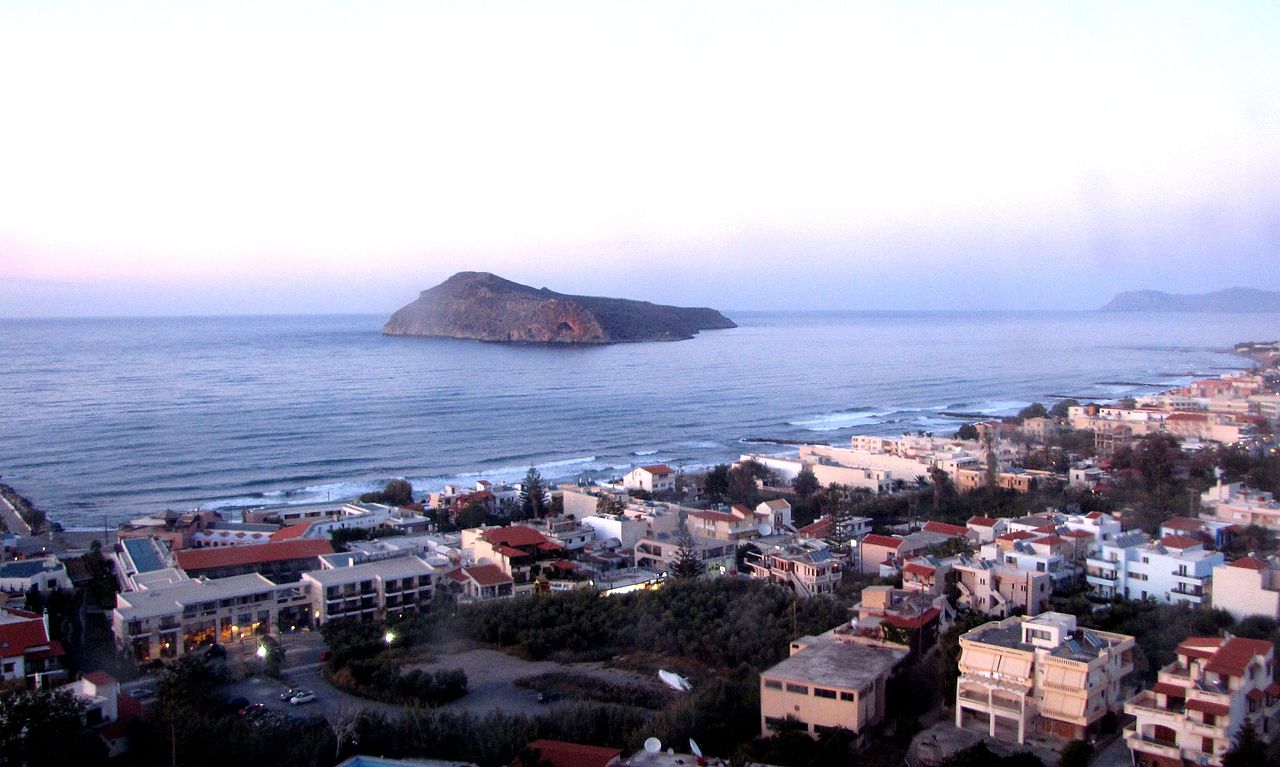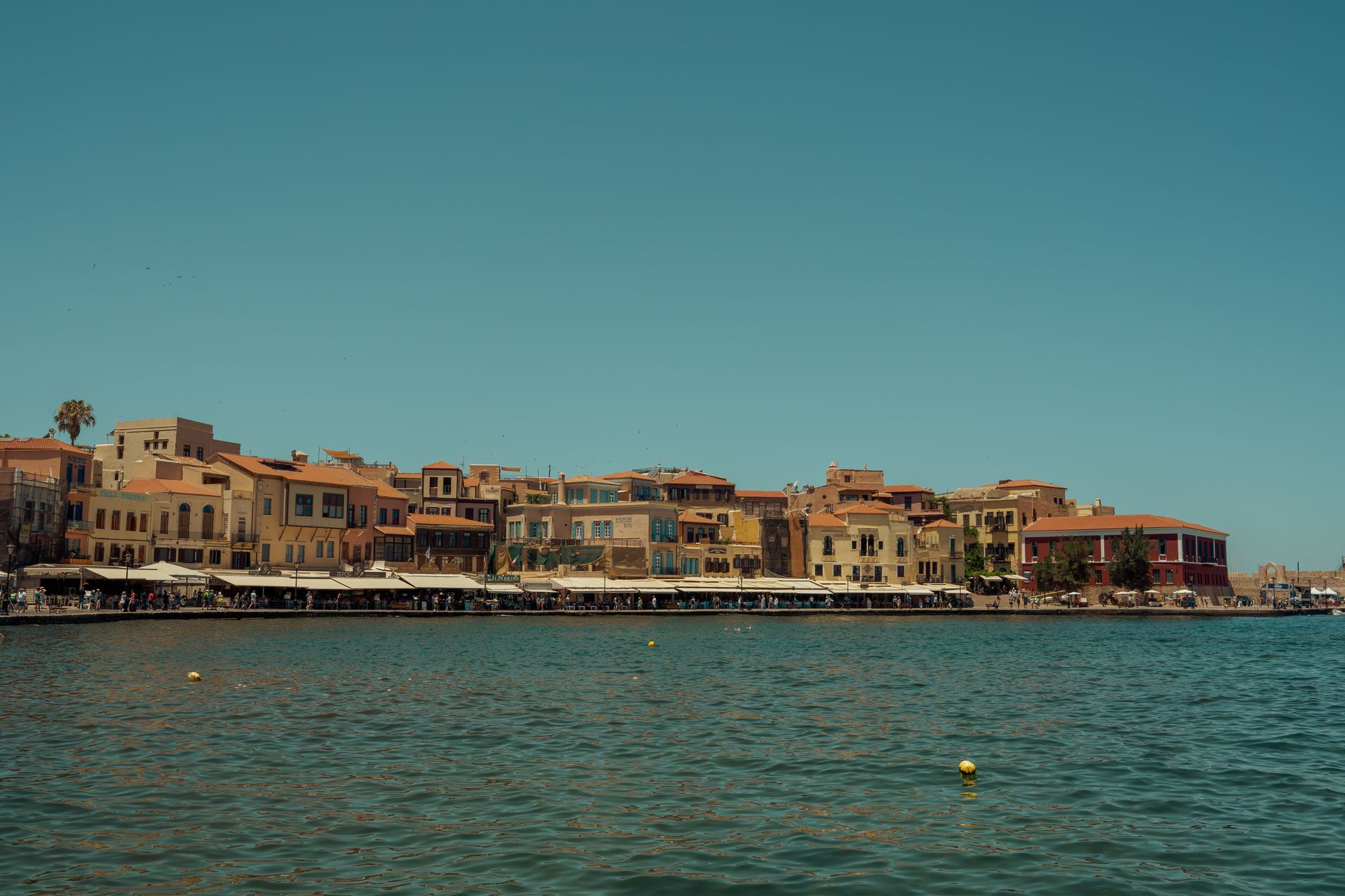
Walk along any port in Crete and you will see them: restaurants on the waterfront, a host at the door calling out to passing tourists, laminated menus with photos of moussaka and grilled octopus. Every coastal town on the island has its row of these establishments. They are not accidental. They are a specific business model, and it is not designed in your favour.
The logic behind that model is unflattering: a restaurant that needs to intercept strangers cannot survive on return business or local reputation. It has no structural incentive to cook well. The harbour view adds 30 to 40 percent to your bill. The food quality is unchanged. This guide explains how to recognise these places before you sit down, and where to eat instead.
- The harbour front trap every tourist walks into
- Why the photo menu is a warning, not a design choice
- Three price signals to read before pulling out a chair
- The Greek salad test
- Where Cretans actually eat in summer
- West coast restaurants worth stopping for
- East and central coast: the honest assessment
- The honest verdict after five years
The Harbour Front Trap Every Tourist Walks Into
The waterfront restaurant is the most reliable tourist trap in Crete. The configuration is consistent: tables pushed to the pavement edge for maximum water visibility, a host positioned at the entrance to greet anyone who slows down, a menu displayed outside in at least four languages. This setup appears on the north coast near Rethymnon Beach, in fishing villages on the east coast near Keratokambos, and along the southern routes toward Plakias Beach. The geography changes. The extraction model does not.
The economics are straightforward. A harbour location in a tourist town costs two to three times more than a street-back location. That premium is passed directly to the customer. A restaurant operating this model is not targeting diners who will return next year with friends: it is targeting the one-time visitor who made no reservations, is hungry after a beach day, and will accept whatever is closest. The food quality is calibrated accordingly.
The signal is not the location itself but the combination: waterfront position, active host at the door, photo menu, and a wine list starting at 35 euros per bottle. Any two of these together is a warning. All four together means you are about to pay a significant premium for food a Cretan would not order.
Why the Photo Menu Is a Warning, Not a Design Choice
A laminated menu with photographs of every dish is the single most reliable indicator of a tourist trap restaurant in Crete. Not because photography is dishonest in itself, but because of what the choice signals: this restaurant targets people who do not read Greek, have no local recommendation, and will almost certainly never return. The consequence is structural. There is no incentive to cook well when your entire customer base is transient and anonymous.
Compare this with how Cretans navigate the same decision. No menu is displayed outside. A chalkboard lists three or four things. You ask the waiter what came in fresh today. The waiter answers without consulting anything. This is not theatre. It reflects a kitchen that decides what to cook based on what was available at the market that morning, not based on a fixed photo catalogue designed to translate across six nationalities.
Taverna Paradise and Taverna Roka on the west coast operate this way. Neither needs to explain its menu with photos because regulars already know what to expect. Socrates Taverna on the east coast follows the same pattern. These places are not difficult to find. They require only a willingness to walk past the first, second, and third restaurant visible from the beach path.
Three Price Signals to Read Before Pulling Out a Chair
Before sitting down, three price signals tell you what kind of restaurant you are entering in Crete.
- Water price: a 0.5L bottle at 3 euros or more is a tourist markup. At a local taverna it costs 1 to 1.50 euros. Ask before ordering if it is not listed.
- Automatic bread with a charge: bread arriving unbidden at 2 euros per person is a tourist menu signal. Local tavernas typically bring small mezedes with drinks at no extra charge, or ask before bringing anything.
- Menu in four or more languages: a laminated menu translated into English, German, French, and Russian tells you this kitchen is cooking for a rotating anonymous clientele, not for a neighbourhood.
A fair benchmark for 2024: grilled fish or lamb, a horiatiki, a carafe of house wine, and water for two people should cost between 35 and 50 euros at an honest local restaurant. If the same order reaches 70 to 90 euros, you paid the view tax in full. Above 100 euros for standard Cretan food, you also paid for the host who called you in from the street.
The Greek Salad Test: Order This Before Committing to a Full Meal
A horiatiki has five components and requires no cooking. It is the purest diagnostic for assessing a Cretan kitchen before you commit to a full meal: ripe tomatoes, cucumber, red onion, kalamata olives, a thick slab of feta, olive oil, dried oregano. No lettuce. No mixed leaves. No feta crumbled over greens.
At a tourist trap, what arrives is a bowl of iceberg, pale tomato slices, a scatter of feta, and olives from a can. The olive oil will be neutral, probably not local. The dish costs 9 to 12 euros. At a table worth sitting at, the same salad costs 6 to 8 euros and the tomato has actual flavour, because it came from a market or garden within 50 kilometres, not from a refrigerated truck originating in Athens.
Order the horiatiki first. Taste the tomato. If it tastes of nothing, pay for the salad and leave. In August, at a table near Plakias Beach or Keratokambos, a local tomato should be among the best you have eaten anywhere. If it is not, nothing the kitchen produces will be worth staying for.
Where Cretans Actually Eat in Summer
In July and August, Cretans largely abandon the waterfront restaurant strips to seasonal tourist trade. They are still eating out, frequently and seriously, but three to five streets back from the water, at tables without sea views, at prices that have not doubled for the high season.
Mezedopolio to pareaki in the central region operates on the format locals trust: small shared dishes, a menu that reflects what the kitchen decided to cook that day, no pressure on table turnover. Thigaterra, also in the central region, follows the same logic. Neither relies on tourist foot traffic to fill its seats.
On the west coast, Grammeno Camping Bar and Restaurant serves regional cuisine to a steady mix of long-term visitors and people from the surrounding area. The food is consistent because the clientele is consistent: people who will come back tomorrow and the day after. Cafe Agia Lake and Thea's coffee shop on the west coast follow the same pattern, built on repeat custom from a local base rather than on first-time tourist capture.
West Coast Restaurants Worth Stopping For
The west coast of Crete retains more intact taverna culture than the north or east coast, partly because the main tourist infrastructure is thinner in several areas. The concentration of tourist traps is still present near the most accessible beaches, but stepping slightly off the primary access roads changes the available options significantly.
Cactus serves Greek cuisine on the west coast and has maintained a mixed clientele of locals alongside seasonal tourists. The reliable test: visit at noon on a weekday in August. If there are Cretan families eating lunch, the kitchen is not running purely on tourist capture mode.
Bahar and Evie's are both west coast options without a fixed cuisine label, which typically indicates a flexible seasonal menu driven by what is available locally. This can mean excellent cooking or inconsistent cooking depending on the week. Ask what arrived fresh before ordering fish or seafood.
Restaurant Italiana on the west coast serves Italian food and pizza. The tourist trap risk at Italian restaurants in Crete is structurally lower: expectations are calibrated differently, and a pizza is harder to fake convincingly than a moussaka assembled from a base that arrived frozen from a central supplier.
East and Central Coast: The Honest Assessment
The east coast near Palm Beach Vai, the most photographed beach on the island, has the highest density of tourist-capture restaurants anywhere in Crete. Any establishment within 500 metres of the famous palm grove is pricing for maximum seasonal extraction. Factor in a 20 to 30 percent premium and expect proportionally less in return.
Bloom and Socrates Taverna operate on the east coast. The same test applies as elsewhere: visit at weekday lunchtime, not Saturday evening. The clientele mix at noon tells you whether the kitchen is cooking for local regular trade or for purely transient tourist flow. Tavern Afentis, also on the east coast, benefits from a position slightly removed from the main beach circuits, which structurally reduces its dependence on first-time tourist traffic.
In the central region, Paralia serves Greek food and seafood. The central coast runs a spectrum from busy resort beaches near Rethymnon Beach and Agia Pelagia Beach to quieter stretches near Plakias Beach and the villages around Keratokambos. Restaurant quality tracks this divide fairly directly. The further you are from a beach with a sunbed concession, the better your chances of eating well.
The Honest Verdict After Five Years
There is no shortage of good food in Crete. There is a real shortage of willingness to walk five minutes away from the beach path before deciding where to eat. Every tourist trap on this island survives because tourists keep choosing the convenience of a visible waterfront table over the effort of finding something better. That is a legitimate choice when you are tired and hungry after a day at Sougia Beach or Plakias Beach. The industry prices it accordingly.
Two rules that hold: first, never eat at the first restaurant visible from the beach access path. Walk inland for at least five minutes. Second, if the menu outside has photographs and is available in four languages, keep walking.
The food in Crete is genuinely excellent. Most restaurants that target tourists do not serve it.