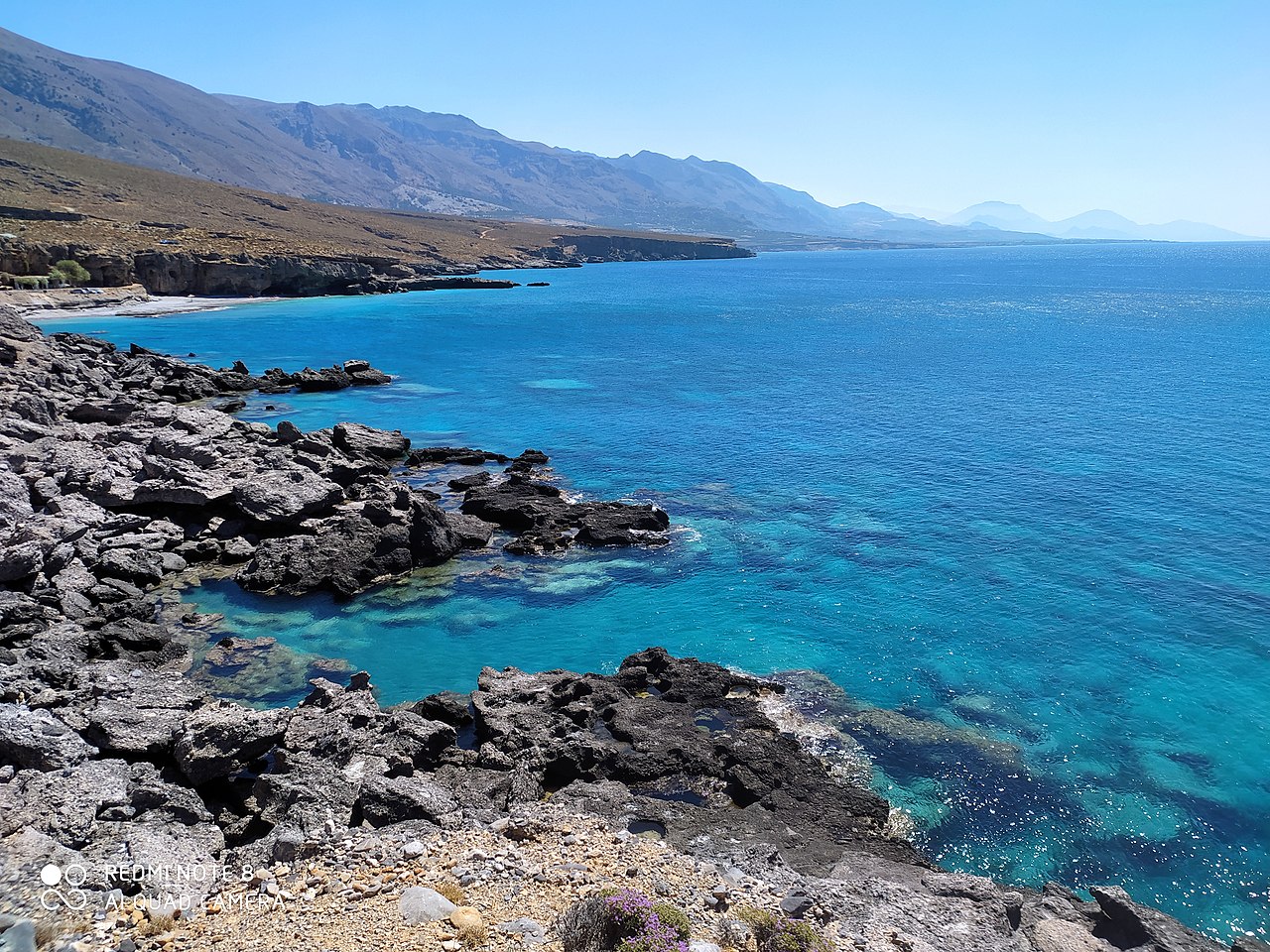
Why Buy Property in Crete in 2026
Crete is Greece's largest island: 8,336 km², 1,046 km of coastline, 650,000 permanent residents and roughly 7.5 million tourists per year. It sits 280 km south of Athens and operates two international airports — Heraklion (HER) and Chania (CHQ) — with a third, Kastelli International, under construction in eastern Crete (projected capacity: 18 million passengers per year, targeted opening 2028).
Buying property in Crete remains 20–30% cheaper per square metre than comparable Mediterranean markets such as Mallorca or the Amalfi Coast, while rental demand is structural rather than speculative. Peak season runs May through October, with July and August coastal villa rates of €200–400 per night. Outside peak season, Heraklion, Chania and Rethymno sustain year-round residential rental demand.
Two infrastructure projects are reshaping valuations in 2026. The BOAK motorway (east-west axis) is compressing travel times to eastern Crete, and the Kastelli airport will replace Heraklion's current airport entirely. Both projects are accelerating price appreciation in Lasithi Prefecture. For a current read on what is developing on the island, the Crete news recap from 14 June 2026 covers recent updates relevant to buyers tracking the market.
Greece's Golden Visa program continues to run in 2026, giving non-EU buyers a pathway to EU residency through property acquisition. The investment threshold in Crete depends on municipality density: €800,000 in high-demand zones, €400,000 in lower-density areas. Most of inland and eastern Crete qualifies at the lower threshold. Your lawyer confirms the exact classification for any specific plot.
Crete Real Estate Prices by Region
Price per square metre varies sharply across the four prefectures. Here is the Crete real estate landscape by zone in 2026:
Chania Prefecture (West Crete)
Chania old town Venetian townhouses: €2,500–5,000/m². High acquisition cost but the strongest short-term rental performers on the island. The Apokoronas region — villages like Vamos, Gavalochori and Kalyves, 25–35 km from Chania — runs €1,200–2,200/m² for stone houses with land, popular with British and German buyers. Coastal Platanias and Agia Marina: €1,800–3,200/m² for apartments. Sea-view land in Tavronitis or Kolymvari starts from €80,000 for 500 m². For buyers drawn to nature tourism, the villages near the White Mountains — Lakki, Askifou, Omalos — offer renovation properties from €40,000, at €600–1,200/m².
Rethymno Prefecture (Central-West)
Rethymno town centre: €1,500–2,800/m². The hinterland (Gerani, Episkopi, Armeni) is the best value mid-island zone: stone ruins for renovation from €60,000, completed houses from €120,000. Coastal apartments in Stavromenos or Adelianos Kampos: €1,400–2,200/m².
Heraklion Prefecture (Central)
Heraklion city: €1,800–3,500/m² for quality apartments. Northern coastal strip (Ammoudara, Linoperamata): €1,600–2,600/m². South towards the Messara Plain, agricultural land with building permits from €50,000. Hersonissos and Malia — the island's main short-term rental belt — run €2,000–3,400/m² for furnished sea-view apartments.
Lasithi Prefecture (East Crete)
Agios Nikolaos: €1,500–2,800/m² for standard apartments, up to €6,000/m² for waterfront. Elounda sees luxury villa prices from €500,000 to €3 million+. Ierapetra and Sitia offer the island's lowest entry points: stone houses from €45,000, coastal land from €30,000 per 1,000 m². This is the zone with the highest upside tied to the Kastelli airport.
The Legal Process: Step by Step
The Crete property purchase follows Greek national law. EU citizens face no ownership restrictions. Non-EU nationals can purchase freely in most of Crete, but zones classified as paramethoria (border areas) — including parts of eastern Crete near military installations — require a permit from the Ministry of Defence. Your lawyer checks this during due diligence.
- Greek tax number (AFM) — required for all transactions. Obtainable at any local tax office (eforia) with a passport. Takes 1–2 days.
- Greek bank account — required for fund transfers. Eurobank, Alpha Bank and Piraeus Bank all accept non-residents. Allow 2–4 weeks.
- Hire a Greek property lawyer (dikigoros) — not legally mandatory but practically essential. The lawyer runs title searches, checks the National Cadastre for encumbrances, verifies outstanding ENFIA debts, and confirms the property's legal status. Budget €1,500–4,000 depending on property value and complexity.
- Preliminary agreement (simvasi prokatarktiki) — a private contract signed by buyer and seller. Deposit at this stage: typically 10% of the agreed price. If the buyer withdraws, the deposit is forfeited. If the seller withdraws, they owe double the deposit.
- Notary (symboleografos) — all Greek property transfers require a notary. The notary drafts and reads aloud the final deed (symboleografio agorapoleesias). Notary fees are set by law at approximately 1–1.5% of the declared value.
- Land Registry (Ktimatologio) registration — final step confirming legal ownership. Registration fees: 0.5–1% of property value.
Time from offer to completion: 4–10 weeks for clean titles. Inherited properties, rural plots with unclear cadastre boundaries, or properties with illegal constructions can take 3–6 months. Estate agents charge 2–3% plus 24% VAT, typically borne by the buyer. Never use an agent as your sole legal counsel, regardless of how helpful they are.
Taxes, Fees and the Real Acquisition Cost
The listed price is the starting point, not the finishing point. On a Crete real estate investment, budget 10–14% above the purchase price for all acquisition costs:
- Property Transfer Tax (FMA) — for properties with a building permit issued before 1 January 2006: 3.09% of the tax-assessed objective value (not necessarily the transaction price). For new construction (first sale, permit post-2006): 24% VAT applies instead. Most resale properties fall under the 3.09% regime.
- Notary fees — 1–1.5% of declared value, VAT included.
- Lawyer fees — 1–2% of property value.
- Land registry — 0.5–1%.
- Estate agent commission — 2–3% + 24% VAT.
On a €250,000 property, total acquisition costs typically run €22,000–35,000. On a €600,000 villa, allow €60,000–85,000 on top of the purchase price.
Ongoing annual costs to factor in:
- ENFIA (annual property tax) — approximately 0.28% of assessed value. A €250,000 property generates roughly €400–800 ENFIA per year depending on zone coefficient.
- Building communal charges (koinochresía) — for apartments: €50–200/month depending on building services.
- Income tax on rental income — Greek progressive rates: 15% on income up to €12,000; 25% on €12,001–24,000; 35% on €24,001–35,000; 45% above €35,000. All rental income must be declared through the myProperty platform, regardless of amount.
- AMA short-term rental licence — required to list on Airbnb, Booking.com or equivalent. Fee: €500–1,000, valid 3 years. Operating without an AMA risks fines of €5,000–50,000.
Rental Yields: What the Numbers Actually Show
Crete's short-term rental market has 15+ years of data. Here are realistic gross yield ranges for investing in Crete property in 2026:
- Coastal 2-bedroom apartment (Hersonissos, Malia, Platanias) — purchase price €180,000–220,000; peak rate €100–150/night; occupancy 65–75% over six months; gross annual income €14,000–22,000; gross yield 7–10%.
- 3-bedroom villa with pool (Apokoronas, Rethymno hinterland) — purchase price €350,000–550,000; peak rate €200–350/night; occupancy 55–70%; gross income €28,000–52,000; gross yield 6–9%.
- Luxury Elounda waterfront villa — purchase price €800,000–2,000,000+; peak rate €400–1,200/night; occupancy 40–55%; gross yield 4–6%, with stronger capital appreciation prospects in a supply-constrained luxury segment.
After deducting property management (15–20% of revenue), cleaning, maintenance and taxes, net yields land at 3.5–6% for well-positioned properties — in line with Southern European comparables, but with additional upside from infrastructure-driven appreciation in eastern Crete.
One structural advantage Crete has over purely beach-dependent islands: Crete's 3,500 years of documented history — from Minoan palaces at Knossos to Venetian harbours in Chania and Rethymno — generates cultural and archaeological tourism that extends the bookable season into May, June, September and October. This shoulder-season demand reduces revenue concentration risk compared to islands with a pure beach proposition.
Practical Checklist Before You Sign
Before committing to any Crete real estate purchase, verify the following:
- The property is registered in the National Cadastre (Ktimatologio). Unregistered rural plots cannot be legally transferred in Greece.
- No outstanding ENFIA debts. These transfer with the property, not the seller.
- All structures have building permits. Illegal additions — semi-covered terraces, pool houses, converted garages — are extremely common and can generate fines or forced demolition orders after purchase.
- For land: confirm road access to a public road. Landlocked plots require a notarised right-of-way agreement with neighbouring owners.
- For coastal properties: confirm the plot does not fall within the 50-metre aigialos zone (public beach zone) where private construction is restricted.
- Zone designation: agricultural land (agrotike ge) cannot carry residential construction unless the plot exceeds 4,000 m² and lies outside a settlement plan boundary.
- Non-EU buyers: confirm whether the specific location falls within a paramethorio zone requiring Ministry of Defence approval before purchase.
Skipping or economising on legal due diligence is the single most common and costly mistake foreign buyers make in the Greek market. A qualified Greek property lawyer is not optional — it is the most important €2,000–4,000 you will spend in the entire transaction.