Who Were the Minoans? Origins and Bronze Age Timeline
The Minoan civilization was Europe's first advanced urban society, flourishing on the island of Crete from approximately 3000 BCE to 1100 BCE. Named after the mythical King Minos by British archaeologist Arthur Evans following his excavations at Knossos in the early 1900s, the Minoans built a sophisticated maritime empire that dominated trade across the eastern Mediterranean for over a millennium.
Genetic and isotopic studies confirm that the Minoans were largely indigenous to Crete, with ancestry tracing back to Neolithic farmers who arrived from Anatolia around 7000 BCE. A smaller percentage of genetic material links to populations from continental Europe and the Caucasus, reflecting gradual migration and contact over millennia rather than a single founding event.
Key Minoan chronological periods:
- Pre-Palatial period (3000–1900 BCE): Early village settlements, development of pottery and bronze metallurgy, emergence of trade networks across the Aegean
- Proto-Palatial (Old Palace) period (1900–1700 BCE): First monumental palaces built at Knossos, Phaistos, and Malia; emergence of Linear A script and centralized palace economy
- Neo-Palatial (New Palace) period (1700–1450 BCE): Peak of Minoan power; palaces rebuilt after earthquake destruction; height of Mediterranean trade networks and artistic production
- Post-Palatial period (1450–1100 BCE): Mycenaean Greek takeover; Linear B replaces Linear A; Minoan culture gradually absorbed into broader Aegean Greek civilization
Population estimates for the Neo-Palatial peak place the island at roughly 90,000–100,000 inhabitants, with Knossos housing up to 100,000 people in its broader urban zone — a scale comparable to major contemporaneous cities in Egypt and Mesopotamia.
Minoan Society, Trade, Art and Religion
What distinguished the Minoans from contemporary Bronze Age civilizations was their emphasis on maritime trade over land conquest, figurative naturalistic art over warfare imagery, and a religion centered on female deities and natural forces. Unlike Egyptian and Mesopotamian palace complexes, Minoan palaces show no fortification walls — interpreted as evidence of either a stable non-militarized society or sufficient naval dominance to render land defenses unnecessary.
Economy and trade networks: Minoan merchants traded olive oil, timber, pottery, saffron, and textiles across a network reaching Egypt, Cyprus, the Levant, mainland Greece, and the broader Aegean. Egyptian tomb paintings from the 15th century BCE depict figures called "Keftiu" — almost certainly Minoan traders — carrying distinctively shaped Aegean vessels as tribute or exchange goods. Crete's central position in the eastern Mediterranean made it the natural hub of Bronze Age commerce.
Linear A and the Minoan language: The Minoans developed at least two writing systems. Hieroglyphic Minoan script gave way to Linear A (c. 1800–1450 BCE), which remains undeciphered. It recorded palace inventories and religious dedications, but without a bilingual key, the underlying Minoan language cannot be read. It is not related to Greek and belongs to an as-yet unidentified language family. When Mycenaean Greeks took control, they adapted the script into Linear B, the earliest deciphered form of Greek, cracked by Michael Ventris in 1952.
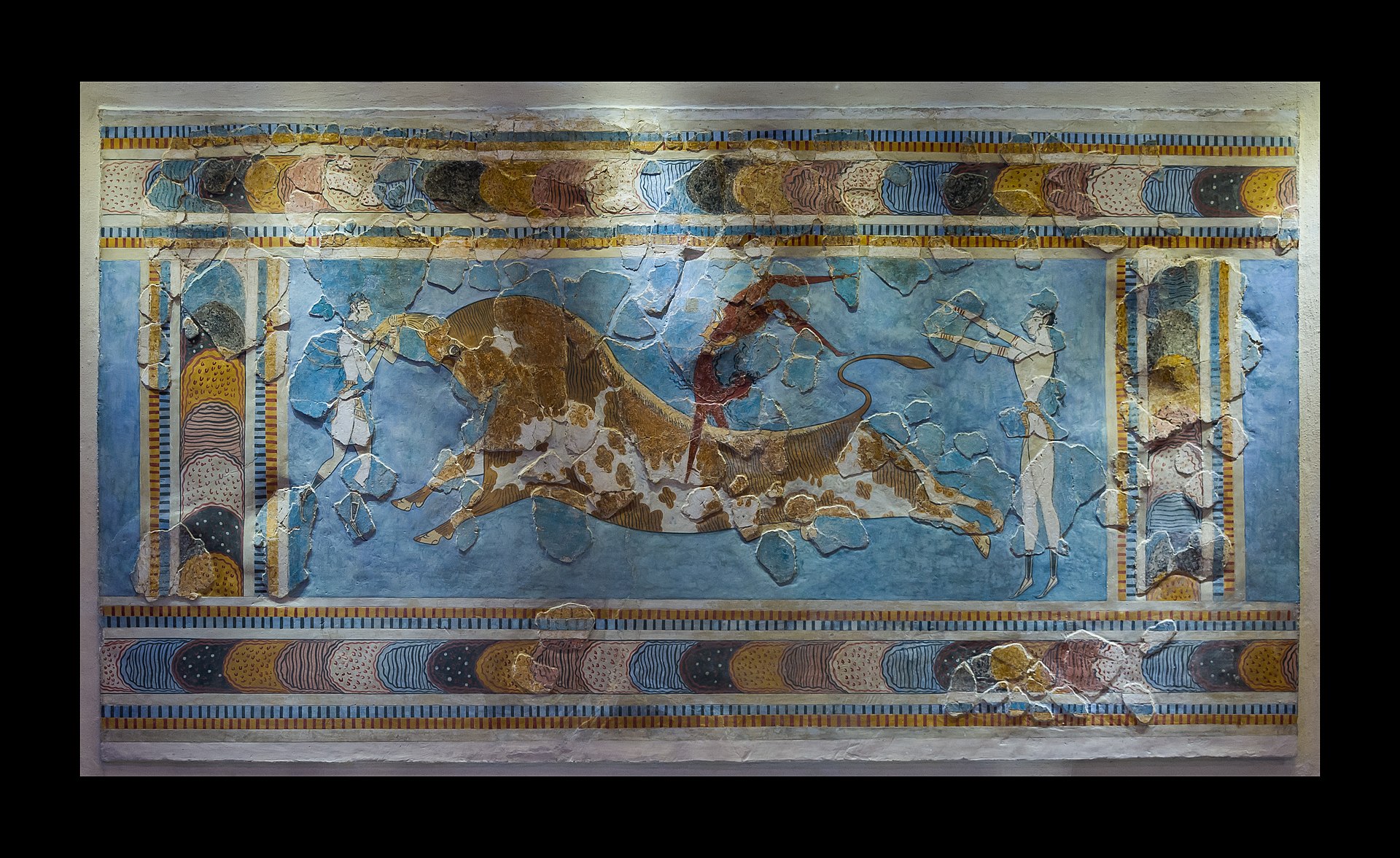
Art and frescoes: Minoan frescoes rank among the finest surviving art from the ancient world. The iconic Bull Leaping fresco from Knossos shows athletes — male and female — vaulting over charging bulls in a ritual practice called taurokathapsia. Other major works include the Ladies in Blue, the Prince of the Lilies, and the Dolphin Fresco. Minoan artists used vivid blues, reds, and yellows on lime plaster, depicting nature, ceremony, and daily life with a fluid naturalistic style centuries ahead of the more rigid formalism of contemporaneous Egyptian art.
Religion: Minoan religious practice centered on goddess worship, peak sanctuaries built on mountaintops, and sacred caves. The Snake Goddess figurines — bare-chested female figures holding serpents aloft — are the most recognizable artifacts of Minoan cult practice. Whether these represent a single deity or a class of priestesses remains debated. Bull iconography and the double axe (labrys, from which the word "labyrinth" is derived) appear extensively across palace architecture and ritual objects — directly connecting Knossos to the later Greek myth of the Minotaur.
The Five Major Minoan Palace Sites Across Crete
Crete preserves five main Minoan palace complexes and dozens of smaller villa and town sites. All are accessible by car; Knossos alone is easily reached by public bus. Distances and entry costs below are accurate for 2026:
Knossos Palace — 5 km south of Heraklion city center. The largest and most visited Minoan site, covering approximately 150,000 square meters across multiple floors. Arthur Evans controversially restored large sections in reinforced concrete in the early 20th century, which helps visitors visualize the multi-storey layout but complicates the purely archaeological experience. Highlights include the Throne Room, Grand Staircase, storerooms with intact pithos storage jars, and reconstructed fresco panels. Ticket: €15 standard, €8 reduced (students and seniors), children under 5 free. For a complete breakdown of entry times, routing, and what to prioritize, read the Knossos Palace Guide 2026.
Phaistos — 62 km southwest of Heraklion in the Messara plain. The second-largest Minoan palace, entirely unrestored and arguably more atmospherically authentic than Knossos. Famous for the Phaistos Disc — a clay disc stamped with 241 undeciphered hieroglyphic signs, now displayed in the Heraklion Museum. Spectacular views south toward the Libyan Sea. Ticket: €8 standard, €4 reduced. Combine with Agia Triada (3 km west, linked ticket available) for a full-day excursion from Heraklion.
Malia — 34 km east of Heraklion on the northern coastal road. A mid-sized palace with well-preserved storerooms and the unique kernos stone: a flat circular stone with 34 small cups used for ritual grain or liquid offerings. Ticket: €6 standard, €3 reduced. Straightforward day trip from Heraklion or from north coast resort areas between Heraklion and Agios Nikolaos.
Zakros (Kato Zakros) — 130 km east of Heraklion, accessible via Sitia (44 km south). The easternmost Minoan palace, discovered largely intact in 1961 because it was abandoned suddenly — leaving palace treasures in place. Located at the foot of the Zakros Gorge, known as the "Valley of the Dead" for its Minoan-era rock-cut tombs. Ticket: €6 standard. Remote but exceptional; plan a full day including the 4 km gorge walk. An overnight in Sitia or Ierapetra is practical.
Agia Triada — 3 km west of Phaistos. A Minoan villa complex rather than a full palace, it yielded some of the finest artifacts in the Heraklion Museum: the Harvester Vase, the Chieftain Cup, and a painted limestone sarcophagus depicting Minoan funerary ritual in rare detail. Typically combined with Phaistos on the same excursion.
If you are planning to visit both Heraklion-area sites and the southwestern sites around Phaistos, the Heraklion to Chania transport comparison 2026 outlines the most efficient routing options — several pass through or near the Messara plain where Phaistos and Agia Triada are located.
The Collapse of Minoan Civilization: Thera, Mycenaeans, and the Bronze Age Collapse
The end of the Minoan civilization was not a single catastrophic event but a multi-phase collapse spanning roughly three centuries, from approximately 1600 to 1100 BCE. Two primary drivers are well established in the archaeological record.
The Thera eruption (~1600–1550 BCE): The volcanic eruption of Thera (modern Santorini), 110 km north of Crete, was one of the largest volcanic events of the last 10,000 years — estimated at VEI 6–7, ejecting 30–60 cubic kilometers of material. It generated tsunamis, deposited ashfall across the eastern Mediterranean, and likely disrupted agriculture through temporary volcanic cooling. The eruption entombed the Minoan settlement at Akrotiri on Santorini under meters of ash, preserving it in remarkable detail — the site is now one of the most important Bronze Age excavations in Europe. The precise eruption date is debated between ice-core evidence (suggesting ~1628 BCE) and traditional ceramic-based chronology (~1500 BCE); current scholarship leans toward 1600–1550 BCE.
The eruption did not destroy Minoan civilization immediately. The Neo-Palatial period continued afterward with rebuilt and expanded palaces. It likely weakened economic and political structures enough to accelerate subsequent collapse.
Mycenaean takeover (~1450 BCE): Around 1450 BCE, nearly all Minoan palaces outside Knossos were destroyed simultaneously. The most widely accepted explanation is Mycenaean Greek military intervention from the mainland. Knossos then continued under Mycenaean administration for roughly a century, as evidenced by Linear B tablets recording Greek-language palace inventories found at the site. By approximately 1380–1350 BCE, Knossos too was destroyed and permanently abandoned as a palace center.
Bronze Age Collapse (1200–1100 BCE): The final disappearance of Minoan-influenced culture coincided with the broader Bronze Age Collapse that destroyed or severely weakened virtually every major eastern Mediterranean civilization — the Hittite Empire, Mycenaean Greek palatial culture, the city of Ugarit, and the Egyptian New Kingdom. Causes remain actively debated: climate-driven drought, Sea Peoples migrations, internal social disruption, and trade network failure are all implicated in the archaeological and paleoclimate evidence.
Heraklion Archaeological Museum and Practical Visiting Tips for 2026
The Heraklion Archaeological Museum is the essential complement to visiting Minoan palace sites. Located in central Heraklion, 10 minutes on foot from the Venetian harbor, it holds the world's finest collection of ancient Crete artifacts across 27 rooms. Key objects to prioritize:
- Snake Goddess figurines (faience, c. 1600 BCE) — Room IV: the defining image of Minoan religious iconography
- Bull Leaping fresco and Ladies in Blue — Room XIV: originals from Knossos, not reproductions
- Phaistos Disc (original) — Room III: 241 stamped hieroglyphic signs, still undeciphered
- Gold Bee pendant from Malia — Room IV: one of the finest examples of Minoan goldsmithing
- Harvester Vase from Agia Triada — Room VII: a black steatite vessel depicting a procession of 27 agricultural workers in extraordinary detail
- Zakros rhytons and Palace treasures — Room VIII: ritual vessels found intact at the eastern palace
Ticket: €15 standard, €8 reduced, combined entry with Knossos Palace available for €20 — the best value if visiting both on the same trip. Open Tuesday–Sunday 08:00–20:00 in high season (June–September); reduced hours October–May. Closed Mondays year-round.
Best time to visit Minoan sites: May, June, September, and October offer the most comfortable conditions. July and August regularly see temperatures exceeding 35°C at exposed hilltop sites like Phaistos, where shade is minimal. For real-time conditions before planning your day at an open-air site, the Crete Weather 14 June 2026 guide provides current temperature, wind, and UV index data.
Getting between sites — logistics for 2026:
- Knossos: city bus 2 from Heraklion central bus station, €1.70, every 15–20 minutes, 20 minutes travel time — no car needed
- Phaistos and Agia Triada: rental car or organized tour required; approximately 1 hour 20 minutes from Heraklion by road via the E75 and national road south
- Malia: 40 minutes east of Heraklion by car or intercity KTEL bus (Heraklion–Agios Nikolaos line, ~€4)
- Zakros: rental car strongly recommended; 2 hours from Heraklion, or base yourself overnight in Sitia (44 km away)
- Audio guide at Knossos: €5 and worth it — on-site interpretive signage is sparse relative to the complexity of the site
Families visiting with children will find that Minoan mythology provides a natural entry point into Bronze Age history. The Minotaur, the Labyrinth, Theseus, and Ariadne are directly connected to the palace at Knossos, and most children already know the story. The Crete with Kids family guide 2026 covers age-appropriate archaeological itineraries that combine site visits with beach days across the island.
For students of ancient Crete history seeking broader coverage, the Sitia Archaeological Museum (eastern Crete, free admission) covers regional Minoan material from the eastern sites, and the Archaeological Museum of Rethymno adds context on post-Bronze Age periods. The island's concentration of Bronze Age remains is unmatched anywhere in Europe.


