Knossos receives 1.5 million visitors a year. Phaistos receives a fraction of that. Every tour operator on the island will push you toward Knossos first, and most visitors go without question. After five years on this island and multiple visits to both sites, the case for Phaistos is clear, with one condition: you need to know what you are looking at before you arrive.
Knossos is visually dense, reconstructed in concrete and paint by Arthur Evans between 1900 and 1935, and designed to tell a story. Phaistos does none of that. It sits on a hill above the Messara plain, open to the sky, with original stone floors and no reconstruction. What you see is what the archaeologists uncovered. That is either more or less interesting than Knossos, depending on what you came to Crete for. This article gives you the facts to decide.
- The Reconstruction Problem: What Knossos Is Not Telling You
- The Phaistos Disk: The Most Famous Object You Will Not See Here
- The Setting: Why the Location Matters
- Crowds and Timing: When to Visit
- What Phaistos Tells You About Minoan Civilization
- On-Site Experience: What to Actually Look At
- Combining Phaistos with the South Coast
- Who Should Visit Phaistos (and Who Should Not)
- Verdict: The Honest Answer
The Reconstruction Problem: What Knossos Is Not Telling You
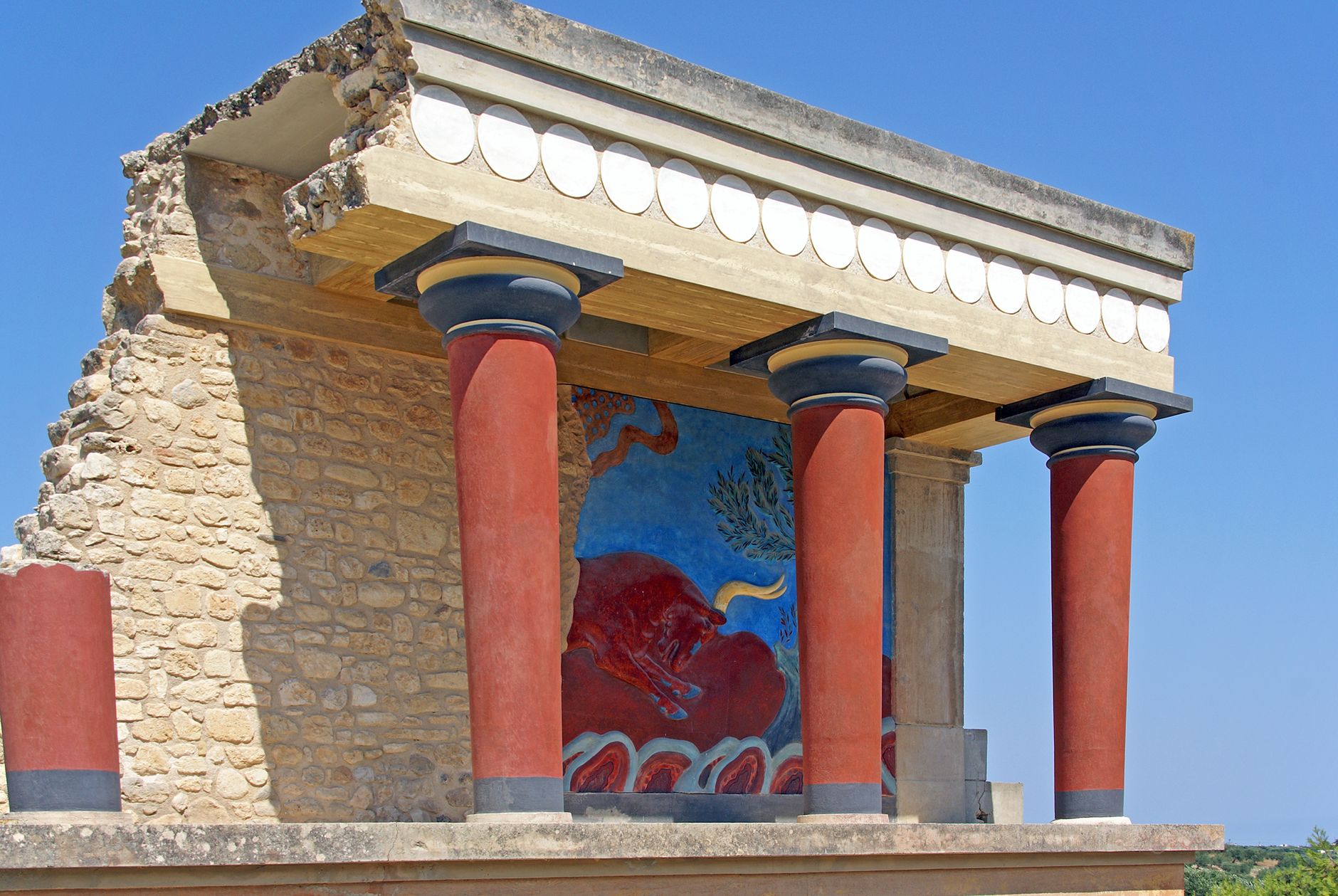
Most visitors leave Knossos believing they have seen a Minoan palace. They have seen Arthur Evans' interpretation of one. The reconstruction work Evans directed between 1900 and 1935 used reinforced concrete, painted plaster, and considerable artistic licence. The vivid frescoes you photograph at Knossos are largely modern paintings based on small fragments of original material. The red columns are reconstructed. The labyrinth narrative owes more to Greek myth than to the archaeological record.
Phaistos has never been reconstructed in this way. The Italian Archaeological School of Athens has worked here since 1884, with a conservative approach by modern standards. What you walk through is what the archaeologists found: stone floors, stairways, storage magazines, and courtyard spaces. No one painted the walls or rebuilt the columns in concrete.
This changes the entire experience. At Knossos, you interpret a reconstruction. At Phaistos, you look at original material, which means confronting the limits of what we actually know about Minoan civilization. For visitors with any serious interest in archaeology, that ambiguity is more valuable than Evans' confident narrative. The two sites are not telling you the same story. They are not even telling the same type of story.
The Phaistos Disk: The Most Famous Object You Will Not See Here
The Phaistos Disk is the most significant object ever found at this site, and it is not here. Discovered in 1908 in a storeroom of the palace, the disk is a fired clay object 16 centimeters in diameter, covered on both sides with 241 stamped symbols arranged in a spiral. No one has deciphered it. The script does not match Linear A, Linear B, or any other known writing system. Archaeologists genuinely do not know what it says, or what it was for.
The original is in Room IV of the Heraklion Archaeological Museum. A replica is available at the Phaistos site shop. If you arrive expecting to stand next to the disk, you will be disappointed. The correct sequence is: visit the Heraklion museum first, spend time in Room IV with the disk and the other Minoan objects, then drive south to Phaistos. The site makes considerably more sense after the museum.
What the disk does confirm is that Phaistos was a significant administrative center, not a minor outpost. The palace complex covers approximately 8,000 square meters. It controlled the Messara plain, the most fertile agricultural land in Crete. The disk was found here, not at Knossos. That detail is worth keeping in mind when comparing the two sites.
The Setting: Why the Location Matters
Before you enter the site, the location alone separates Phaistos from every other Minoan palace in Crete. The palace sits on a ridge at approximately 100 meters above sea level, overlooking the Messara plain to the south and east. The Psiloritis massif rises to the north. On a clear day, which covers most of the year outside July and August, the view from the upper court extends across 20 kilometers of cultivated plain: olives, vines, greenhouses stretching to the horizon.
Knossos sits in a scrubby valley on the outskirts of Heraklion. The setting is suburban. There are no meaningful views. The site logic is compressed because Evans rebuilt so much of it vertically. At Phaistos, the spatial organization of the palace is readable from the elevated points: west court, grand staircase, central court, storage magazines to the north. You understand the building before you have read a single information panel.
The drive from Heraklion takes 60 to 75 minutes through the Messara plain. From a base on the south coast or in a village in the central interior, it is considerably shorter. There is a small cafe at the site entrance and a shop with publications and replicas. Neither is remarkable. The view from the parking area already is.
Crowds and Timing: When to Visit
Even in August, Phaistos remains manageable in a way that Knossos simply is not. In peak season, Knossos receives upwards of 5,000 visitors per day. Queue times at the entrance exceed 30 minutes on busy mornings. The site is exposed, shade is limited, and the density of tour groups makes it difficult to spend quiet time in any single area of the palace.
Phaistos in the same period receives an estimated 500 to 800 visitors per day. The difference is visible the moment you arrive. Tour buses do come, typically between 10:00 and 12:00. Arriving before 09:00 or after 14:00 gives you long stretches of the site with few other visitors present.
- Opening hours: approximately 08:00 to 20:00 in summer, reduced in winter
- Entrance fee: approximately 8 EUR for adults (Knossos: 20 EUR)
- Shade: minimal inside the site, bring a hat and water in summer
- Time needed: 90 minutes for a thorough visit without rushing
- Parking: free, 5 minutes' walk from the entrance
- Audio guides: available at the ticket office
The combination of lower cost and lower crowds is not a niche discovery. It is information that does not circulate widely because Phaistos has no marketing budget and no branded experience to sell. That absence is, incidentally, part of what makes the visit worthwhile.
What Phaistos Tells You About Minoan Civilization
Phaistos is more informative than Knossos about how Minoan society actually functioned, if you know what to look for. The palace was first built around 1900 BCE and destroyed by an earthquake around 1700 BCE. The Minoans rebuilt it on the same footprint. The second palace was then destroyed around 1450 BCE, probably by the same series of seismic and volcanic events that affected much of the Aegean. Both construction phases are visible on site, and the transition between them is one of the more legible stratigraphic sequences in Minoan archaeology.
The storage magazines along the north wing demonstrate the palace's economic function clearly. Pithoi, large ceramic storage jars, remain in situ in some of these rooms. The palace was a redistributive center: agricultural surplus from the Messara plain came in, was stored and administered, and went out. The Phaistos Disk, the administrative tablets found nearby, and the storage facilities all point to the same conclusion. This was not primarily a ceremonial space. It was an economic and administrative hub with ceremonial functions. The distinction matters for understanding Minoan society.
The west facade includes some of the finest ashlar masonry in any Minoan structure: stones cut and fitted without mortar, with precision still measurable 3,500 years later. You can examine the joints between the stones. They are consistent to within a few millimeters. That level of craft is not incidental. It is a political statement in stone.
On-Site Experience: What to Actually Look At
Most visitors spend their time in the most photogenic areas and miss the most informative ones. The grand staircase collects the majority of photographs: fourteen steps, each approximately 14 meters wide, rising from the west court to the propylaeum. Walk it slowly. The scale is deliberate, designed to communicate authority before you have even entered the palace proper.
The west court itself deserves more attention than it typically gets. The large paved space was used for public gatherings and possibly theatrical or ceremonial performances. The raised causeway running across it is original Minoan construction. It is easy to cross it without registering what it is.
The central court is where most visitors rush through en route to the next photogenic element. Do not do this. The central court is the organizational hub of the palace: storage magazines to the north, royal apartments to the northeast, lustral basins to the west. The paving is original Minoan work.
- West court: orientation point, original raised causeway, public assembly space
- Grand staircase: most photographed, read the scale as a deliberate statement
- Central court: organizational hub, original paving, do not rush through
- Storage magazines, north wing: pithoi in situ, clearest evidence of economic function
- Northern section: least visited, most complete Minoan domestic architecture on site
The northern section of the site, beyond the central court, is the area most visitors miss entirely by turning back too soon. It contains some of the most complete Minoan domestic architecture on the island. The stone is well-preserved, the room relationships are legible, and there are almost never other visitors there.
Combining Phaistos with the South Coast
Phaistos works best as part of a south coast day, not as a standalone trip from Heraklion. The drive from Phaistos to Matala takes 20 minutes heading west. Matala is a village on the south coast with a beach, tavernas, and a series of sea caves carved into the sandstone cliffs above the shoreline. The caves served as Roman tombs before being occupied by an international hippie community in the late 1960s. The beach is modest and crowded in summer; the village is functional rather than polished.
East of Phaistos, the road through the Messara plain reaches Keratokambos on the central south coast in approximately 45 minutes. Keratokambos is a quiet settlement on a pebble beach with clear water and minimal tourist infrastructure. It has not been developed in the way that north coast resort areas have. A taverna, a few rooms, clear water: that is the offer.
A practical structure for the day from a south or central base:
- 08:30 · arrive at Phaistos before the midmorning tour groups
- 10:30 · leave Phaistos, drive toward the south coast
- 12:00 · lunch at a taverna in Matala or at Keratokambos
- Afternoon · beach, then return to base before evening traffic
Total driving does not exceed 90 minutes. This is a complete and coherent day that does not require a Heraklion base and avoids the north coast congestion that defines the summer season on the main road.
Who Should Visit Phaistos (and Who Should Not)
Phaistos is not the right site for every visitor to Crete, and being direct about that is more useful than a blanket recommendation. The site requires some prior preparation to get full value from it. The on-site information panels are present but not comprehensive. There are no dramatic reconstructions to anchor your understanding visually. If you arrive without any knowledge of Minoan chronology, you will spend 45 minutes looking at stone walls without a framework to place them in.
Phaistos is the right choice if:
- You have some prior interest in archaeology or ancient history
- You have already visited Knossos and want a contrasting perspective
- You value original archaeological fabric over reconstructed narrative
- You are building a south coast day around Matala or Keratokambos
Knossos may suit you better if:
- This is your first exposure to any Minoan site
- You are visiting with children who need visual stimulation to stay engaged
- You have a single day in Crete with no prior background in ancient history
The mistake is not choosing one over the other. The mistake is arriving at Phaistos expecting Knossos, or assuming that Knossos alone gave you a complete picture of Minoan civilization on this island.
Verdict: The Honest Answer
Phaistos is not the most visited Minoan site in Crete. It is the most authentic one. No concrete, no painted reconstructions, no mythology layered over the archaeology by a well-funded Edwardian with a theory. What you get is original stone, clear spatial organization, and a view of the Messara plain that explains why the Minoans built here in the first place.
If you have already visited Knossos, Phaistos will reframe what you saw there. If you have not yet been to Knossos, start at Phaistos. You will go to Knossos afterward with better questions and more skepticism about what you are looking at. The entrance fee is lower, the crowds are thinner, and the experience is less mediated. That combination is not easy to find in Crete during the summer months.